


18 October 2026
How to Dose Flour Improver in a Mill: Feeder Calibration and Blend Uniformity
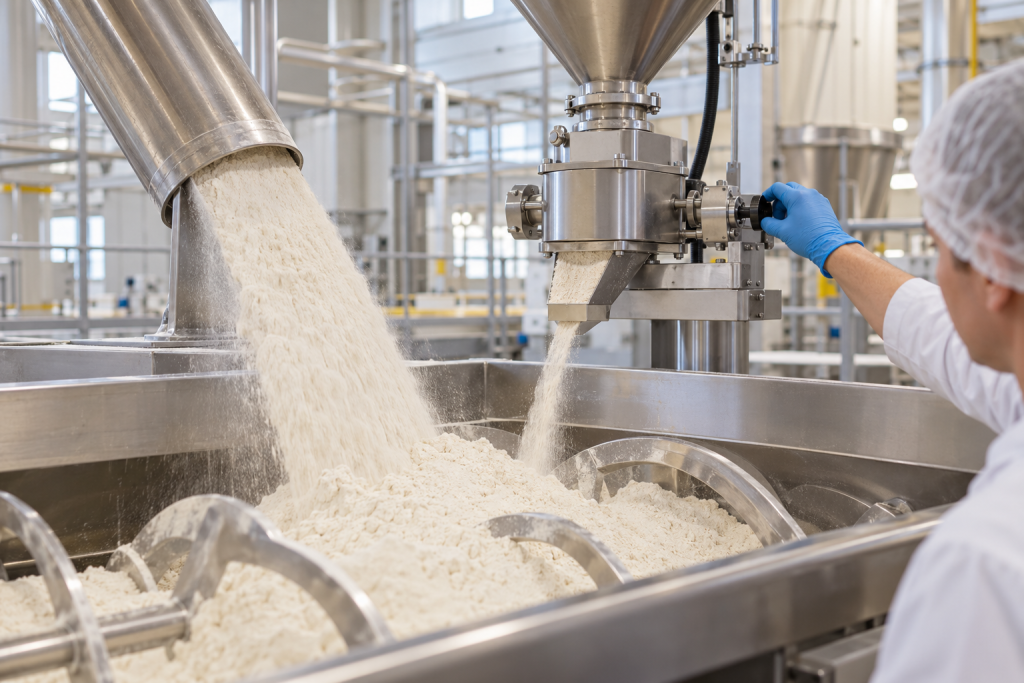
Choosing a flour improver is only part of the job at a mill. The result also depends on feeding the intended amount at a stable rate and distributing it evenly through the flour stream. Unstable dosing can create differences between shifts and batches even when the formula on paper has not changed. This guide is for mill process, quality and procurement teams. It focuses on process control; the use rate for any product must follow its technical specification, applicable regulations and a validated plant trial.
Review Nandoran flour-improvement products and contact technical support to assess your line. This article does not replace a product label or regulatory approval, and it does not prescribe one universal dose for every flour.
What flour-improver dosing is meant to control
Dosing aims to deliver a defined amount of improver per mass of flour and to distribute it consistently through the product flow. A correct average is not enough if some flour is overdosed and some is underdosed. Variation is more likely when a feeder pulses, powder bridges in the hopper, line speed changes without a matching feeder signal, or a low-rate ingredient is not blended with a compatible carrier where technically permitted.
Collect the process data before installing or adjusting a feeder
1. Confirm the material specification
Record the product name, lot number, physical form, moisture sensitivity, bulk density and storage instructions from the technical documents for that product. Powder flow properties affect feeder selection and settings. Do not substitute an informal recommendation or data from a supposedly similar material.
2. Map the line and injection point
Measure the actual flour flow at minimum, typical and maximum production rates. Select an injection point that provides suitable downstream mixing and can be inspected and cleaned while limiting dust and cross-contamination. If flour throughput changes through a PLC command, the feeder should track the same signal; otherwise, the ratio can drift during a slowdown, speed change or stoppage.
How to calibrate the dosing feeder
- Reproduce production conditions. Use the same material, hopper, transfer path and operating speed as the real line.
- Collect feeder output. At several settings and defined time intervals, capture and weigh the discharge; record the test conditions.
- Compare with flour throughput. Calculate the ratio using compatible units and measured flow. Operators should not have to estimate it from memory.
- Check repeatability. Recalibrate after a product or lot change, feeder maintenance, a transfer-path change or a noticeable shift in feed behaviour.
- Verify independently. A suitable weighing check, sampling plan or laboratory test should confirm actual process performance for that material and regulation.
WHO guidance for quality assurance in wheat-flour fortification emphasizes feeder calibration, feed-rate calculation, sampling and record keeping in its own context. These are useful process-control principles, but that guidance does not specify bread-improver dosing rates.
Blend uniformity and segregation risk
Differences in particle size or density can cause a blend to segregate during transfer and handling. Reduce the risk by keeping the transfer route manageable and cleanable, avoiding long residence in unsuitable bins, and sampling at different points and times. A composite sample can assess the average, but separate time-based samples are also needed to reveal process variation.
When an ingredient is added at a much lower rate than flour, the technical team can assess pre-blending with a compatible, permitted carrier. The carrier, pre-blend ratio and mixing time must suit the material, equipment and applicable requirements. Do not change the formula or add a carrier without technical approval.
Records and batch traceability
At a minimum, keep the improver and flour lot numbers, target rate, line speed, feeder setting, weighing or sample result, operator, adjustment times, stoppages and corrective actions in the shift record or quality system. Trends over several weeks are often more useful than one isolated check for identifying a blockage or gradual performance drift. Record product and shift changes so that differences can be explained.
Troubleshooting checklist
- Under- or overdosing: review the scale, unit conversion, line-speed signal and feeder setting together.
- Shift-to-shift variation: standardize hopper filling, start-up procedure and operator training.
- Change after a new lot: compare bulk density and flow behaviour with the product specification, then reassess calibration.
- Caking or interrupted flow: check moisture exposure, storage, hopper compatibility and cleaning; do not alter the material without technical direction.
- Inconsistent finished flour: take planned samples upstream and downstream to distinguish dosing variation from mixing or flour variation.
Frequently asked questions
Can one feeder setting work for every improver?
No. Flow behaviour, density and other material properties differ. Assess each product and line against its own technical documents.
How often should a feeder be checked?
Set the interval according to risk, supplier guidance, material changes and the mill’s records. Recheck after maintenance or a significant process change.
Does a correct target rate guarantee a uniform blend?
No. Uniformity also depends on stable feeding, mixing, representative sampling and checks on the finished flour.
Monitor the feeder during continuous production
Initial calibration is only a starting point. Establish a monitoring cycle that compares feeder output with actual line speed and flour-flow changes. Scheduled weighing or sampling can be logged alongside throughput and stoppages. Set the number of samples and alert limits according to line capacity and product risk; there is no single plan suitable for every mill.
After a feeder replacement, component change, repair, new lot or gap between target and measured output, the responsible technical lead should decide whether a full recalibration or a focused check is needed. Link records to the material and line so that changes can be compared with earlier trends. If powder feed is unstable, resolve the mechanical or flow issue first; undocumented manual adjustments can hide the cause rather than correct it.
References and further reading
- WHO guidance on quality assurance and quality control for wheat-flour fortification (process-control principles, not a bread-improver use rate)
- ICC Method 130 for sampling milled products