


18 October 2026
Iron and Folic Acid Premix for Wheat Flour: Dosing, Feeder Calibration and Quality Control
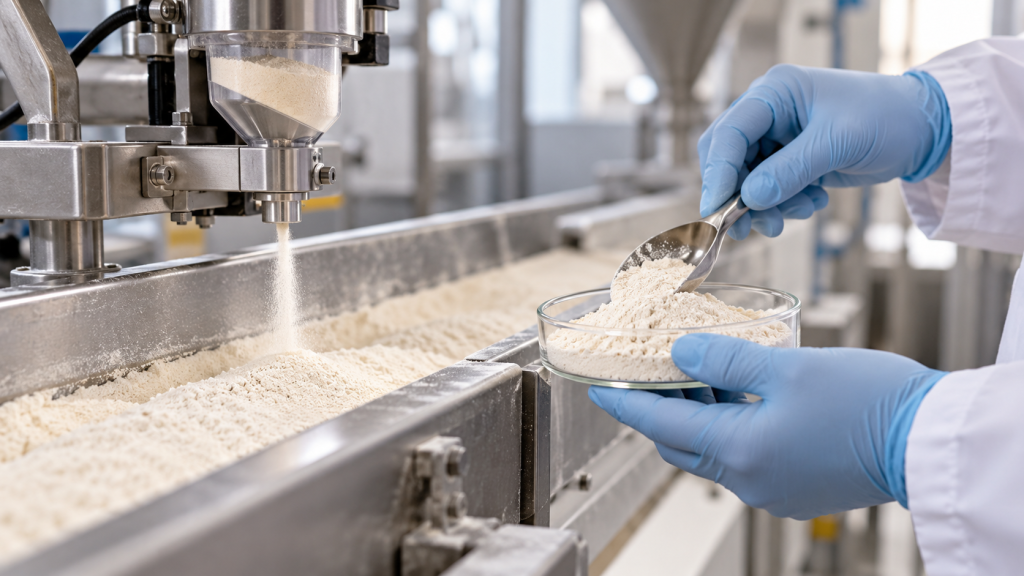
Flour fortification is a production-control task as much as a formulation decision. A mill can purchase a compliant iron and folic acid premix yet still miss its target if the feeder is incorrectly installed, the feed rate is not matched to flour throughput, the premix is poorly stored, or verification records are incomplete. This guide explains how mill teams can build a repeatable dosing and quality-control process without relying on a universal recipe or an assumed dose.
Fortification levels and permitted forms of nutrients must follow applicable national standards and programme specifications. Review the Nandoran product range and contact a technical specialist through the contact page for product documentation; always confirm suitability and dosage for the mill, flour stream and jurisdiction.
What is an iron and folic acid premix?
A premix is a prepared blend of vitamins and minerals used to introduce selected micronutrients into a food vehicle. In a flour-fortification programme, iron and folic acid may be included alongside other nutrients, depending on the applicable standard. The premix specification should state nutrient forms and concentrations, carrier ingredients, handling requirements, shelf life, storage conditions, batch identification and supporting certificates. Do not infer composition from the product name alone: check the current specification and certificate of analysis for each supply lot.
WHO guidance treats wheat-flour fortification as a programme-level public-health intervention and emphasizes decisions informed by local nutritional needs, flour consumption, technical considerations and national policy. This article addresses mill operations and quality systems; it does not prescribe population nutrient levels or replace regulatory requirements.
Calculate the required feeder rate from verified data
The feeder setting depends on the target concentration established by the governing standard, the premix nutrient concentration, the actual flour production rate and the dosing system’s calibration. Use the approved calculation procedure supplied by the programme or technical authority. Before each production run, verify the flour flow measurement and feeder output against that calculation. Never copy a rate from another mill or product without checking the premix composition, target, flour throughput and equipment.
Keep units consistent throughout the calculation and have a second trained person review it. Record the target, assumptions, source of each input, calculation version and sign-off. If production throughput changes, the feeder rate must be reassessed; a fixed feeder setting does not maintain the same addition level when flour flow varies.
Install and calibrate the premix feeder
Check the equipment and the premix path
Inspect feeder installation, hopper condition, agitation, bridging, seals, tubing and the point where premix enters the flour stream. Confirm that the feeder is appropriate for the premix’s flow characteristics and that extraction or dust-control equipment does not remove product from the dosing path. Follow the equipment manufacturer’s instructions for cleaning and maintenance, and prevent cross-contamination between products.
Measure actual output rather than trusting a display
Collect and weigh feeder discharge over a defined time interval, using a suitable balance and the site’s written calibration procedure. Repeat measurements to assess consistency, compare the measured rate with the calculated target and adjust only within the validated operating method. Document the date, operator, equipment identity, set point, measured output, flour throughput, corrective action and final verification. Recheck calibration after maintenance, a feeder change, premix change, abnormal interruption or any significant process adjustment.
Manage storage, handling and traceability
Store premix in its original identified packaging under the conditions specified by its supplier. Protect it from moisture, heat, contamination and prolonged exposure to air or light when the specification requires. Apply first-expiry-first-out stock rotation, keep lot and certificate records, and prevent unidentified partial bags from returning to production. Train operators on safe handling, spill cleanup and the site’s food-safety procedures.
Before use, confirm that the lot is approved for the intended programme and remains within its shelf life. Record the supplier, lot number, receipt date, certificate, storage location and amount issued to the production line. These records support investigation if flour test results or process checks fall outside expectations.
Build a practical quality-assurance plan
Internal monitoring should combine process checks with product verification. Use the schedule defined by national requirements and the mill’s quality system. A practical plan typically identifies who checks each item, when it is checked, the sampling point, the acceptance criteria, what to do when a result is out of range and how records are retained.
- verify flour flow rate and premix feed rate at planned intervals;
- check feeder function, settings, maintenance and calibration records;
- confirm premix lot, certificate, storage and expiry status before use;
- use the prescribed qualitative screening method where required;
- send representative flour samples for quantitative laboratory analysis at the defined frequency;
- compare results with applicable limits and investigate deviations promptly;
- retain batch, sampling, laboratory and corrective-action records.
A qualitative iron spot test, where specified, is a screening tool; it does not quantify every micronutrient. Laboratory methods, sampling design, analytical uncertainty and regulatory limits should be set by competent authorities and the mill’s approved plan. Do not treat a single sample or test as proof of perfect homogeneity across every production lot.
Control blending and sampling variability
Premix addition alone does not guarantee even distribution. Evaluate the injection point, mixing or blending capacity, flour flow stability and any recycle or bypass streams. During commissioning or after a major process change, map the variation using the sampling approach specified by the quality programme. Take samples from representative points and label them with time, line, flour lot and operating conditions. If results vary, inspect both feeder performance and the flour-mixing stage before changing the target addition.
Common problems and corrective checks
Low or inconsistent test results
Check whether the feeder output was measured, whether the flour rate matched the calculation, whether the premix lot was correct and whether sample handling was appropriate. Verify the test method and laboratory controls before adjusting dosage.
Feeder output fluctuates
Inspect bridging, hopper level, vibration, auger condition and feed interruptions. Confirm that the premix is being handled within its specified moisture and storage conditions. Recalibrate only after correcting the mechanical cause.
Records do not match production
Reconcile flour tonnage, premix issued, remaining inventory and feeder runtime. The mass balance can reveal an unrecorded stop, manual intervention, incorrect shift entry or a measurement problem.
Frequently asked questions
Is there one standard dose for all wheat flour?
No. Target levels depend on the applicable country standard or programme, premix formulation, flour throughput and approved equipment. Use the authorized calculation, not a generic online value.
Does a certificate of analysis replace mill checks?
No. Supplier documentation supports incoming-lot verification, while the mill still needs process monitoring and the product testing required by its quality plan.
Can a premix be used past its expiry if it looks normal?
Do not rely on appearance. Follow the supplier specification and site procedure; quarantine uncertain material and obtain approval from the responsible quality or regulatory contact.