


Evaluating Bread Improvers on a Production Line: From Comparative Trials to Purchasing
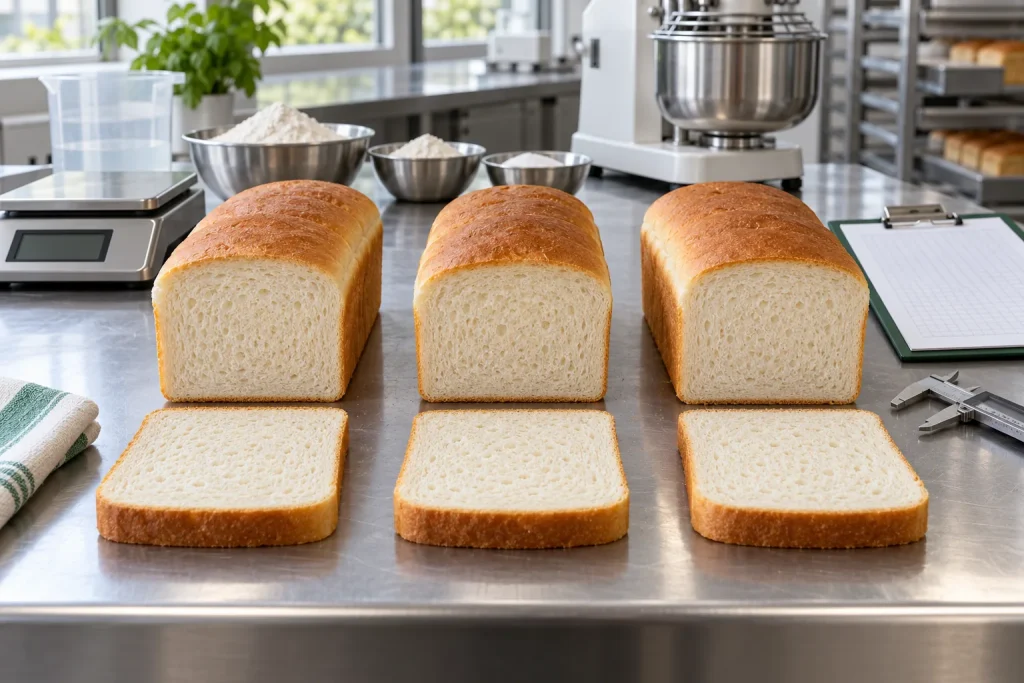
A larger loaf from a single bake is not enough to select a bread improver. A suitable formulation must perform with your flour, equipment and production schedule, and do so consistently. A comparative production trial helps separate the formulation’s contribution from changes in water, mixing, fermentation and flour quality.
This guide proposes a practical trial framework. It does not report test results for Nandoran products. Explore Nandoran products and solutions before discussing a trial for a particular application.
What do bread improvers do in commercial baking?
Depending on their composition, improvers support dough handling, process tolerance, crumb structure or texture retention. These are different functions: no single formulation should be assumed to provide them all. Enzyme-based systems also depend on the enzyme selected and the available flour substrate. Certain specialised amylases, for example, can help delay crumb firming; that is not a claim of mould control or microbiological safety.
For sliced pan bread, even texture and clean slicing may matter as much as volume. Baguette production has different requirements for shape, crust and crumb. Define success around the intended bread rather than choosing the tallest loaf.
1. Define the production problem before starting
Choose a primary outcome and acceptance limits
“Better quality” cannot be measured consistently. Specify the actual issue: tearing at the moulder, variable loaf height, slicing waste or excessive firming during storage. Decide how and when it will be measured before reviewing the results. Acceptance limits must reflect your product specification and line capability; there is no universal pass value for every bakery.
Record constraints too. A volume gain is not useful if loaves are damaged during packaging or fail the target weight, colour, flavour or labelling requirements. The trial procedure should be feasible during normal shifts, not only under unusually careful pilot conditions.
2. Use a meaningful reference and comparable conditions
The reference is normally the approved current production formulation. Removing all improver is only an appropriate control when the resulting process and product remain acceptable. Comparing a new formulation today with a different flour delivery baked last week cannot isolate the reason for a difference.
- Record flour lot, package opening date and storage conditions.
- Record dough piece weight, final mixing temperature, rest times, proofer settings and bake conditions.
- Distribute samples across relevant oven or tray positions so a position effect is not mistaken for a formulation effect.
- Repeat independent batches, preferably on more than one production day. Several slices from one loaf are not independent production repeats.
Should water stay constant?
Decide whether you are comparing formulations at fixed conditions or comparing each formulation at its best practical settings. Both are useful questions, but they are not the same experiment. When water is adjusted, document the amount and the decision rule. Greater water addition is not automatically a benefit: handling, complete baking and storage quality must also remain acceptable.
3. Take the dose from the product specification
A dose may be expressed against flour weight, dough weight or another basis. Check the technical sheet before comparing percentages. As an arithmetic example only, a specified dose of 0.3% on flour weight means 300 g for 100 kg of flour. This example is not a recommendation for any particular product.
Use a scale with adequate resolution at the required weight and distribute powders consistently. Do not stack improvers or active ingredients without checking the combined formulation. For process records, see the dough temperature and mixing control guide.
4. Measure quality at consistent checkpoints
| Checkpoint | Record | Common confounder |
|---|---|---|
| After mixing | Temperature, stickiness and moulding behaviour | Unrecorded changes to water and mixing time |
| After baking and cooling | Weight, dimensions, crumb uniformity and waste | Comparing warm and fully cooled bread |
| During storage | Softness, slicing and sensory characteristics | Different packaging or storage temperatures |
Use sample codes for sensory comparisons to reduce brand bias. Without a texture analyser, define a repeatable internal assessment and disclose its limitations; a manual check is not equivalent to a standard instrument method. Softness does not establish food safety or replace shelf-life validation.
5. Compare cost per saleable product
Improver price per kilogram is only one input. Include dose cost per batch, rejects, permitted rework, downtime and the number of saleable packs. Equal purchase prices can hide different use rates and yields. Keep final weight and quality comparable, and do not treat an unsupported yield claim as a measured saving.
When should a trial be repeated?
Separate a batch from the main comparison if flour changes unexpectedly, weighing fails or sample identification is lost, and document the reason. Do not discard an unfavourable result merely because it contradicts expectations. One successful batch does not establish robust production performance.
Turning trial data into a purchasing decision
A useful bread improver trial combines a clear objective, a valid reference, documented dosing and repeat production. The preferred formulation should meet quality needs, line requirements and the cost target for saleable bread. Contact Nandoran’s technical team with the flour specification, bread type and production issue to discuss an appropriate trial.
Technical source and scope
IFF’s baking enzyme overview was consulted for general enzyme functionality. The trial workflow is a proposed production-control framework, not a substitute for product instructions, local regulations or a validated laboratory method.