


Bread Improver Storage: Moisture Control, Caking and Open-Pack Handling
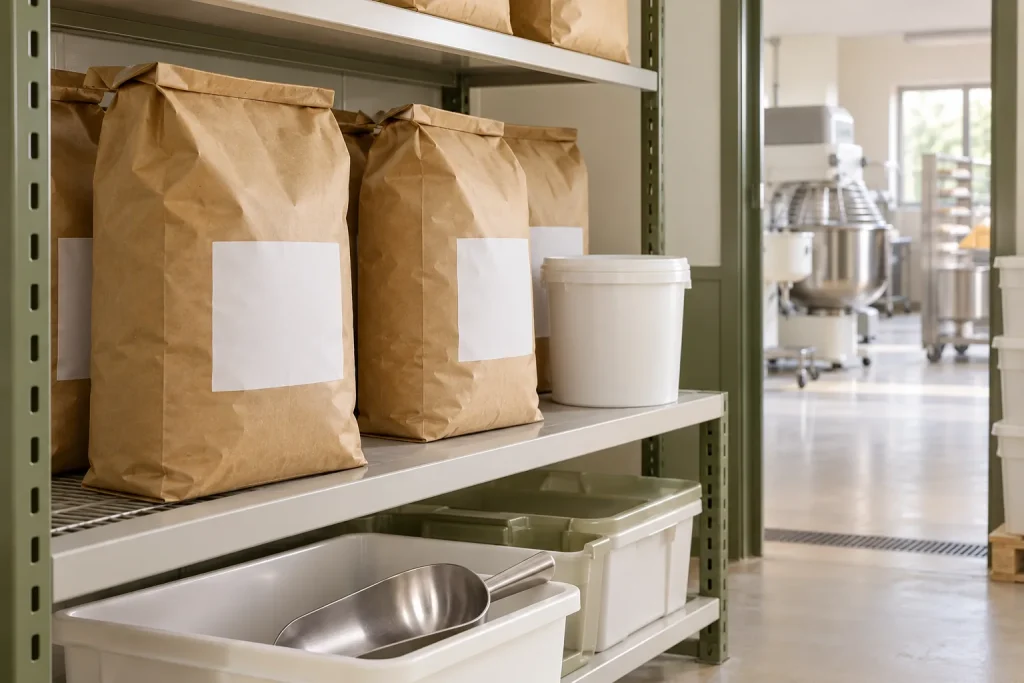
A bread improver can support consistent production only when its formulation, dose and handling are appropriate. Storage conditions need attention until the powder reaches the mixer. A sound package received into a suitable storeroom may later be left near steam or handled with a damp scoop. Open-pack control therefore deserves its own procedure.
This guide focuses on powdered bread improvers and proposes practical controls for bakeries. Obtain temperature limits, humidity requirements, shelf life and instructions after opening from the label and technical sheet for the actual product. There is no single storage specification for every formulation.
Why the product specification comes first
Improvers differ in composition, carriers and packaging. Calling a material a dry powder does not establish its permitted storage temperature or usable life. Before purchasing, ask about transport conditions, unopened storage, resealing and the assessment of damaged packs. Start with the Nandoran product and solution range when discussing a particular application.
Official information for certain Lesaffre Saf Pro products recommends cool, dry storage and protecting opened packs. Those are product-specific instructions: their stated shelf life must not be transferred to a Nandoran product or another formulation.
1. Check the delivery before releasing it to production
Match the package to the order
Record the full product name, formulation code, lot number, declared date and quantity. Do not identify similar powders by bag colour. Keep the original identification readable throughout use. Set aside a pack with tears, moisture marks, an open seal or an identity mismatch for assessment before it enters production.
Record unusual receiving conditions, such as a wet outer carton or an unsuitable unloading location. This does not automatically classify the product as defective; it preserves information needed for a release decision. Make the acceptance or hold decision traceable to the responsible person and supplier correspondence.
2. Separate bulk storage from daily handling
Give unopened packs a defined storage location that can be cleaned and inspected. Keep them away from cleaning chemicals, wash stations and steam sources. Preserve access to labels and package surfaces; tightly packed storage that prevents inspection makes control more difficult.
Codex General Principles of Food Hygiene emphasises protecting ingredients from contamination and providing storage suited to their nature. A site’s own procedure should translate broad principles into a clear layout, assigned responsibility and records that can be reviewed.
Where should conditions be monitored?
When the product sheet sets environmental limits, monitor the actual storage area rather than assuming an adjacent office represents it. Define inspection times and locations in the internal procedure. If a limit is exceeded, record not only the reading but also the duration, affected packs and the quality team’s disposition.
3. Establish specific rules for opened packs
Mark the opening date and responsible operator, and close the pack as instructed after each withdrawal. Where transfer to a daily-use container is permitted and needed, use a clean, dry, food-contact-suitable container. Transfer the product identity and lot number too. An unlabelled container invites an error even if its contents are intended for the same shift.
- Use an identifiable, dry scoop dedicated to the appropriate product.
- Do not top up an old residue with a fresh lot without an approved procedure.
- Transfer only the required working quantity to the weighing station and avoid leaving the main pack open.
- Ask the supplier about the permitted period after opening; the unopened-pack date does not answer that question by itself.
4. Respond to caking through a documented assessment
Caking alone does not establish its cause or confirm product suitability. If powder condition differs from the expected specification, hold the pack and record the lot, observation time, storage history and photographs. Follow the quality procedure and manufacturer guidance for a decision.
Sieving, crushing or increasing the dose should not be an automatic response to a suspect pack. Restoring an even appearance does not supply the missing information about its condition. Equally, do not attribute low loaf volume to storage without checking flour, weighing, dough temperature and processing separately.
5. Combine stock rotation with release status
Under first-expired, first-out, or FEFO, an approved pack with the nearest declared expiry takes priority. Receipt date alone is insufficient: a later delivery may have an earlier expiry. A held pack must not be issued merely because it is older.
| Event | Record | Decision |
|---|---|---|
| Delivery | Product, lot, dates and package condition | Accept or segregate for assessment |
| Opening | Opening date and working container | Resealing and use period from product instructions |
| Issue to production | Lot, quantity and production reference | Match the material to the recipe |
| Deviation | Condition and affected packs | Hold, assess and document disposition |
6. Connect storage records to the production batch
If a bread batch performs differently, you should be able to identify the improver lot used. Recording the lot alongside the actual weighed quantity establishes this link. The production trial guide for bread improvers explains a structured comparison. Documented storage is an input to interpreting a trial, not a replacement for measuring dough performance.
Frequently asked questions
Should every bread improver be refrigerated?
No. Follow the actual product’s instructions. Adding a cooling step without manufacturer guidance is not a substitute for compliant storage. Discuss changes in storage conditions and opening practice with the supplier.
Does normal appearance confirm suitability?
Appearance is only one observation. Product identity, dates, package integrity and storage history also need to remain traceable. A deviation requires a decision through the responsible quality process.
How can a bakery start a storage procedure?
Collect current technical sheets for the materials actually used, then assign receiving, storage and weighing responsibilities. Contact Nandoran for guidance relating to the selected product rather than applying a generic shelf-life claim.
Sources and scope
General principles were checked against official Lesaffre Saf Pro storage information and Codex General Principles of Food Hygiene. The operational checklist is a proposed framework and does not replace a product specification or the site’s approved procedure.